
Open Student Thesis Offers
When writing your thesis at TUM I6, please follow our thesis guidelines. A guide to writing good thesis can be found here. A collection of useful material for research can be found here.

Embodied Intelligence and Autonomous Robotic Systems
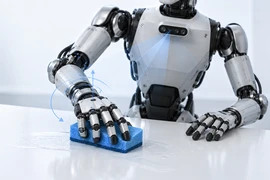
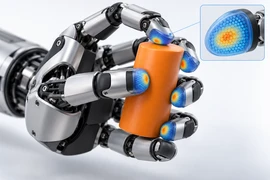
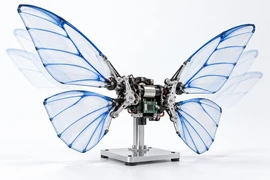
Keywords: Embodied AI, Autonomous Robotics, Robot Perception, Robot Learning, Motion Planning and Control, Dexterous Manipulation, Bioinspired Robotics, Mechatronics
- [SA/MA/BA] Real Time Safety for Vision Language Action Robots
- [SA/MA/BA] From Spoken Instructions to Robot Execution with Signal Temporal Logic
- [SA/MA/BA] Real Time Salient Object Detection for RGB and RGB D Video
- [SA/MA/BA] All Terrain Obstacle Avoidance Across Land Water and Air
- [SA/MA/BA] Mechatronic Design and Control of a Butterfly Inspired Robot
- [SA/MA/BA] Vision Language Action Learning for Humanoid Hand Tool Use
- [SA/MA/BA] Whole Body Control for the Unitree G1 Humanoid
- [SA/MA/BA] Tactile Sensing for Dexterous Robotic Hands
- [SA/MA/BA] Real-Time Crowd Navigation Using Dynamic Risk Maps
Our research in Embodied Intelligence and Autonomous Robotic Systems explores how robots can perceive their surroundings, understand human instructions, and act safely and effectively in the physical world. Our projects bring together vision-language-action models, real-time visual perception, language-driven task specification, and robot planning and control. Applications span navigation across land, water, and air, butterfly-inspired mechatronics, humanoid whole-body control and tool use, and dexterous manipulation with tactile sensing. We welcome bachelor’s and master’s students who want to connect intelligent algorithms with physical robotic systems. Whether you already have relevant experience or are eager to learn, these projects offer opportunities to develop your skills through hands-on research in robotics, AI, and mechatronics.
If you are interested in related topics or have your own project ideas beyond the listed proposals, feel free to contact us with your CV and transcript attached.
For more information, please contact Dr. rer. nat. Yu Zhang( zy.zhang@tum.de )
Robot Learning and VLA for Robotic Manipulation
We are looking for students interested in foundation models and VLA.
[SA/BA/MA] Real-to-Sim-to-Real for Scaling Robot Learning
If you are interested in on of the topics or if you like to propose a topic regarding Robot Learning and VLA, please contact Hang Li (hang1.li@tum.de) and Dr. Zhenshan Bing ( zhenshan.bing@tum.de).

Foundation Models for Autonomous Driving, Intelligent Transportation and Human-Machine Interaction - MITNAND Project
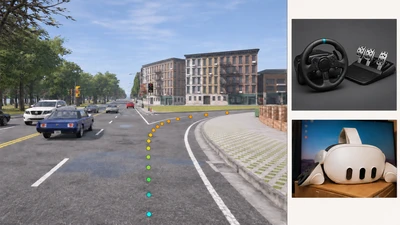
We are looking for students interested in multimodal foundation models for autonomous driving, intelligent transportation systems, and human–machine interaction. You are also welcome to propose your own research topic based on your interests. Currently, available topics are as follows.
- [BA/SA/MA/GR/IDP/FP] Vision-Language-Action Model for End-to-end Autonomous Driving
- [BA/SA/MA/GR/IDP/FP] Immersive Virtual Reality Interface for Autonomous Driving in CARLA
For more information and potential topics, please send your latest CV, academic transcripts, and a short letter of motivation to Yinglei Song (yinglei.song@tum.de).
Humanoid Robots for Railway Safety Testing: RemODtrAIn


Posted October 2026
Keywords: Humanoid Robotics, Legged Locomotion, Reinforcement Learning, Physics Simulation, Footstep Planning, SLAM, Sim-to-Real
Autonomous trains rely on AI-based obstacle detection to recognise people on or near the track. Validating these systems requires realistic, repeatable test scenarios, but testing with real pedestrians is unsafe. In the research project RemODtrAIn, carried out together with Siemens Mobility, we use humanoid robots as intelligent pedestrian surrogates that can walk, stand and cross tracks in realistic railway environments. To do so, the robot must move reliably on challenging terrain such as ballast, sleepers and rails.
- [BA/SA] Railway Simulation Environments for Humanoid Robot Learning
- [MA] Global Foothold Mapping and Planning for Humanoid Robots
- [MA] Precise, Height-Adaptive Foothold Control for Humanoid Robots on Railway Tracks
We are looking for students interested in humanoid robotics, legged locomotion, simulation and robot learning. The projects involve work with a real humanoid robot. If you are interested in related topics or have your own project ideas beyond the listed proposals, feel free to contact us with your CV and transcript attached.
For more information, please contact Sami Mentes (sami.mentes@tum.de) and Marc Ziegler (marc.eric.ziegler@tum.de)
Whiskered Nermo

We aim to design and fabricate a whisker-inspired tactile sensor to enable exteroceptive sensing and further enhance agility via animal primitives imitation for a biomimetic mouse robot. Owing to the whisker's mechanical flexibility and low computational cost, it is ideally suited for assisting the biomimetic mouse robot in navigating confined, poorly lit, and unstructured environments. Ultimately, together with newly upgraded actuation system this sensor will be integrated into the mouse robot to build a contact-aware locomotion adaptation, biomimicry behavior and tactile SLAM system, serving to enhance both the robot's environmental awareness and its reactive agility during operation. For more information, please directly contact Yixuan Dang.
Imitation Learning and Locomotion Adaptation
Keywords: Imitation Learning, Contact Recognition, Animal Motion Primitives, Agile Locomotion
- [MA|SA|BA] [Active] Imitation Learning of Animal Motion Primitives on a Compact Biomimetic Quadruped Robot
- [MA|SA|BA] [Active] Contact-Aware Locomotion Adaptation for Agile Biomimetic Mouse Robots
Whisker-inspired Tactile Intelligence
Keywords: Whisker Sensor Design, Tactile Odometry/SLAM, Pose Estimate, Multi-Sensor Fusion, Contact Localization, Hydrodynamic Perception
- [MA|SA|BA] [Active] Sensing In Darkness: Design of a Whisker-based Ultra-Compact Exteroception Head Module for Mice Robot
- [MA|SA|BA] [Active] Bioinspired Whisker Arrays for Spatiotemporal Hydrodynamic Perception
- [MA|SA|BA] [Active] Temporal Correspondence of Feature-Dependent Tactile Odometry for Nermo Pose Estimate
For other related previous topics and more information, please direct to my homepage Yixuan Dang (yixuan.dang@tum.de)
Multimodal Sensor-driven Intelligent Interactions for Robotic Manipulation
We are looking for students interested in multimodal sensors, sensor-driven robotic manipulation, and VLA
[New! SA/BA/MA] Interaction-Aware Robotic Manipulation with Triboelectric Effect-Driven Sensing
Interaction-aware robotic manipulation requires robots to perceive human intervention and object-related interaction cues during task execution. Conventional vision may be affected by occlusion, while force/torque or tactile sensors mainly provide information after physical contact. Triboelectric nanogenerators (TENGs) exploit contact electrification and electrostatic induction to provide lightweight and flexible sensing. An existing system on a Franka Panda robot has demonstrated two interaction-aware functions. This project aims to extend them toward intelligent, robust human-robot interaction and object understanding. This topics related to multimodal sensor technology and robot learning, if you're interested, feel free to chat with me about it.
[New! SA/MA/BA] Enhancing Diffusion Policies for Adaptive Robotic Manipulation in Dynamic Scenarios
This project aims to develop methods that enhance the adaptability of diffusion policies trained in stationary environments, enabling them to perform reliably in dynamic scenarios without costly retraining. Existing Diffusion Policies or VLA have emerged as powerful visuomotor models for robotic manipulation. However, their adaptability to changing task requirements at inference time remains limited. For instance, a diffusion-based pick-and-place policy trained with demonstrations from stationary scenarios often fails when faced with dynamic objects during deployment. In such cases, the object may move beyond the workspace distribution seen during training, causing severe out-of-distribution issues. We aim to enhance the policy's adaptability at the inference stage.
If you are interested in one of the topics, please contact Dr. Xiangtong Yao (xiangtong.yao@tum.de)
Embodied AI for Humanoid Robots: From Perception to Dexterous Manipulation
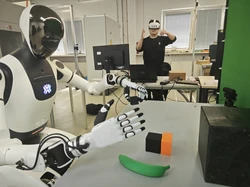
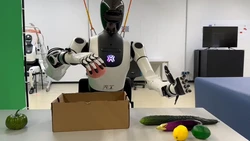
Keywords: Embodied AI, Humanoid Robotics, Dexterous Hand Manipulation, Vision-Language-Action Model, Robot Learning, Reinforcement Learning
- [SA/MA/BA] Learning from Humans: From Cross-Platform Teleoperation to VLA-Based Humanoid Dexterous Manipulation
- [SA/MA/BA] Beyond Grasping: Generalizable Dexterous Manipulation with Vision-Language Model and Reinforcement Learning
- [SA/MA/BA] Cross-Embodiment Robot Collaboration: Towards Collaborative Intelligence in Smart Factories
We are looking for students interested in embodied AI, humanoid robotics, dexterous manipulation, and robot learning. Selected projects also offer internship opportunities. If you are interested in related topics or have your own project ideas beyond the listed proposals, feel free to contact us with your CV and transcript attached..
For more information, please contact Zitao Zhang( zitao.zhang@tum.de )
Continual Reinforcement Learning, Lifelong Learning for Robotic Manipulation
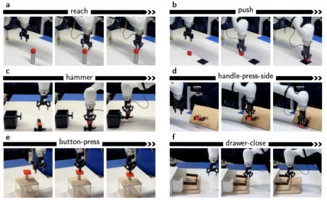
[BA/GR/SA/MA] Diffusion-based Continual Learning for Robotic Manipulation
[BA/GR/SA/MA] Towards Bidirectional Knowledge Flow in Continual Reinforcement Learning
[BA/GR/SA/MA] Adaptive Replay Memory for Robotic Continual Learning
[BA/GR/SA/MA] Vision-based lifelong imitation learning for robotic manipulation
In addition to these topics, we also offer other related fundamental research and platform development projects. We are actively expanding toward more complex robotic manipulation scenarios, developing robust continual learning algorithms for robotics, and deploying them on real-world robotic systems. This work includes many possible topics for exploration.
If you are interested in robotic continual learning, or would like to propose a related topic of your own, please contact Shimin Liu(shimin.liu@tum.de).
Turning Intelligence into Real-World Impact


- Embodied Intelligence
- [GR/SA/BA/MA] Hierarchical Reinforcement Learning for Long-Horizon Tasks (For further details, please feel free to contact me by email)
- [GR/SA/BA] Robot Grasping in Cluttered Environment
- [GR/SA/MA] Memory-Augmented VLA for Long-Horizon Manipulation (Currently not recruiting)
We are always looking for motivated students to join our research efforts. Current openings for thesis and projects focus on Robot Manipulation and Agentic Systems. If you are interested in these research areas, or would like to propose a novel research direction, please reach out via email with your CV and transcripts.
For more information, please contact Tianyao Tong( tianyao.tong@tum.de )
Next-Generation Multi-Domain (Air-Ground-Marine) Robotic Platforms
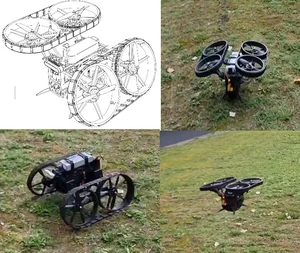

1.Mechanical Design and Integration for Multi-Domain Unmanned Platforms [Robotics] [Mechanical Design]
[BA/SA/MA]: [Proposal](contact: zy.zhang@tum.de, qian.huang@tum.de)
This project explores the fascinating engineering challenge of building cross-domain unmanned platforms capable of seamlessly traversing air, ground, and aquatic environments. We aim to overcome the conflicting physical requirements of these domains—such as aerodynamic efficiency for flight, structural robustness for terrain, and hydrodynamic sealing for water—without relying on bulky, ad-hoc modifications. Building upon our fully functional 1st- and 2nd-generation prototypes, your goal is to design a unified, lightweight airframe featuring innovative morphing mechanisms (such as vector thrust articulation) and robust waterproofing systems. We are actively pushing the physical boundaries of hybrid robotic platforms. If you have your own ideas regarding reconfigurable structures, advanced materials, or rapid prototyping, let's chat!
2.Onboard Electronics and Embedded System Design for Multi-Domain Unmanned Platforms [Robotics] [Embedded Systems]
[BA/SA/MA]: [Proposal](contact: zy.zhang@tum.de, qian.huang@tum.de)
This project explores the critical hardware-software interface that empowers complex, multi-domain robotic platforms. We aim to solve the bottleneck of fragmented electronics by building a unified onboard infrastructure capable of managing aerial, terrestrial, and marine operations simultaneously. Utilizing our existing advanced prototypes, your goal is to design custom, miniaturized PCBs for power management and sensor integration, develop robust embedded firmware (e.g., STM32) for state transitions, and seamlessly integrate open-source flight controllers (PX4/ArduPilot) tuned for unique multi-domain dynamics. We are actively defining the future of unified, plug-and-play electronic architectures for hybrid autonomous systems. If you have your own ideas regarding custom avionics, power distribution, or low-level robotic control, let's chat!
3.Autonomous Algorithms for Air-Ground-Marine Integrated Unmanned Platforms [Robotics] [Algorithm]
[BA/SA/MA]: [Proposal](contact: zy.zhang@tum.de, qian.huang@tum.de)
This project explores the frontiers of autonomous intelligence for hybrid robotic platforms operating seamlessly across air, ground, and aquatic environments. We aim to solve the profound algorithmic complexities of cross-domain navigation—from safety-critical obstacle avoidance on unpredictable terrains to handling severe hydrodynamic disturbances during underwater task execution. Utilizing our state-of-the-art integrated prototypes , your goal is to develop robust algorithms for seamless locomotion mode transitions (e.g., flight-to-water) , agile full-degree-of-freedom underwater maneuvering , and multi-modal perception. We are actively defining the algorithmic "brain" for next-generation multi-domain autonomous systems. If you have your own ideas regarding reinforcement learning-based control, or trajectory optimization, let's chat!
Mentor: Yu Zhang, Qian Huang
Agile Amphibious Locomotion: Design, Control, and Autonomous Navigation of a Miniature Legged Robot

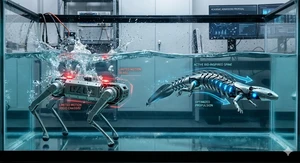
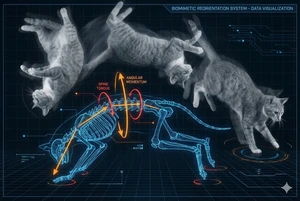
1.[High Priority] Swimming Like a Dog: Mastering the "Dog Paddle" for Amphibious Quadruped Robot [Locomotion]
[BA/SA/MA]: [Proposal](contact: qian.huang@tum.de)
This project explores the domain of Amphibious Locomotion Control and Sim-to-Real Transfer. We aim to solve the dynamic "clumsiness" legged robots face upon entering the water, where complex hydrodynamic forces—like buoyancy and drag—disrupt terrestrial walking gaits. By combining physics-based simulation environments (like Isaac Sim) with advanced control algorithms (Deep RL or MPC), you will build a locomotion framework that mathematically optimizes the rhythmic "dog paddle." Your goal is to enable our amphibious quadruped to efficiently generate forward thrust and maintain 3D stability in fluid environments, successfully deploying these virtual skills onto the physical robot.
2.[High Priority] Landing Like a Cat: Aerial Self-Righting for Amphibious Robots via Active Spine Control [Mechanical Design] [Locomotion Control]
[BA/SA/MA]: [Proposal](contact: qian.huang@tum.de)
This project explores the fascinating intersection of Bio-inspired Dynamics and Aerial Control. We aim to solve the challenge of safe landing for agile robots without adding heavy, single-purpose reaction wheels (dead weight). Inspired by the "cat righting reflex," you will use Active Spine Control to manipulate the robot's angular momentum mid-air. Using physics simulation (MuJoCo/Isaac Sim) and trajectory optimization, your goal is to teach the robot to vigorously twist and reorient its body in milliseconds, ensuring a perfect four-point landing from any drop angle.
Mentor: Qian Huang
Humanoid manipulation, Dex Hand Manipulation, Lifelong learning


Note:
Master’s thesis opportunities are continuously available until December 2028. New thesis topics are released on a rolling basis and are often assigned through internal referrals from former students, so this page may not always reflect the latest openings. For the most up-to-date thesis topics and opportunities, please visit my personal homepage.
1. Cross-Embodiment Lifelong Learning
The demo and recent publication on Nature Machine Intelligence related to this topic can be seen at: https://www.nature.com/articles/s42256-025-00983-2
[SA/MA]: Cross-embodiment lifelong learning leveraging common knowledge representation and continual world model (contact: y.meng(at)tum.de)
In the process of lifelong learning for robots, cross-embodiment knowledge transfer and reuse are often overlooked. This leads to overfitting to specific dynamic embodiments and a lack of generalization. However, embodiments with similar dynamic characteristics hold the potential for direct task knowledge transfer and generalization. Therefore, this project focuses on cross-embodiment knowledge co-representation and transfer during lifelong learning. We propose to use a Mixture of Experts (MoE) architecture to align the inputs and outputs of different embodiments and to construct a shared representation in the latent space. At the same time, we will incorporate a world model to enable the latent space to predict states independent of specific dynamics, aiming to improve the cross-embodiment transfer performance in lifelong learning.
Keywords: Lifelong Reinforcement Learning, Cross-Embodiment, Shared Latent Representation, Transformer, Mixtrue of Experts, Generative Experience Replay, Diffusion Modeling
2. Large Language Models Empowered Humanoid Manipulation
[SA/MA]: Recursive Self-Improved Harness Framework for Humanoid Dual-Arm Manipulation (contact: y.meng(at)tum.de)
Large language models (LLMs) have demonstrated strong potential for autonomous robotic manipulation through code generation and structured tool use. However, reliable long-horizon humanoid manipulation remains challenging due to complex dual-arm coordination, dynamic environments, and execution failures. This thesis aims to develop a recursive self-improving harness framework for humanoid dual-arm manipulation, integrating LLM-based task planning, modular robotic APIs, and closed-loop execution feedback. The framework will enable LLM agents to generate and execute manipulation programs while monitoring execution outcomes, identifying failures, and autonomously refining action strategies. A key focus is on recursive self-improvement, allowing the system to learn from execution failures, iteratively refine generated code, and improve reusable manipulation skills. Students will contribute to the development of the agentic harness architecture, perception and manipulation APIs, and feedback-driven failure recovery mechanisms. The framework will be validated through real-world humanoid manipulation tasks involving dual-arm coordination and autonomous failure recovery. Strong Python programming skills are required, while experience with ROS, LLM agents, or robotic manipulation is preferred.
Keywords: LLM Agents, Code Generation, Agentic Harness, Recursive Self-Improvement, Humanoid Manipulation
[SA/MA]: Vision-Language-Action Model with Humanoid DexHand Manipulation (contact: y.meng(at)tum.de)
Recent progress in Vision–Language–Action (VLA) models and embodied intelligence has brought the robotics community to what many consider the “pre-GPT moment” for robots. However, current VLA models face significant limitations. On the data side, most existing VLA datasets are designed for simple single-arm robots with two-finger grippers, while large-scale datasets for humanoid robots equipped with dexterous hands remain scarce. Meanwhile, internet-scale human videos, an abundant source of prior knowledge for robotic learning, are still underexplored. Correspondingly, existing VLA architectures are not well adapted to highly articulated humanoid robots with dexterous hands, which often involve more than 50 degrees of freedom. This thesis project proposes to leverage human interaction videos for world-model learning, combined with small-scale robot data for hierarchical VLA fine-tuning, to enable dexterous manipulation on humanoid robots. This is an open research topic, and students with strong academic performance (GPA<2.0) or prior research/publication experience are encouraged to apply. Outstanding students may have opportunities to co-author publications.
Keywords: Vision-Language-Action Models, Humanoid Manipulation, Dex Hand, Imitation Learning.
3. RL Post-Training for Humanoid Manipulation
[SA/MA]: RL Post-Training for Failure-Aware Humanoid Manipulation (contact: y.meng(at)tum.de)
We are recruiting students to join a research project on reinforcement learning (RL) post-training for robust humanoid manipulation, with a particular focus on dual-arm decoupled policy optimization and failure recovery. This project aims to enhance the robustness and adaptability of robotic manipulation policies through RL-based post-training on real humanoid robots. Building upon pre-trained robotic policies, we will investigate decoupled learning strategies that enable independent optimization of dual-arm manipulation behaviors while preserving coordinated execution. In addition, we will develop failure-aware recovery mechanisms that allow robots to detect and correct manipulation failures through targeted policy refinement and online interaction. Students will work on the full pipeline, including VR-based teleoperation and data collection, VLA/VA model fine-tuning, RL post-training, and real-world deployment on humanoid platforms. We are looking for students with solid Python programming skills and experience in ROS, while prior experience in reinforcement learning (RL) or imitation learning (IL) is highly preferred. The position requires a minimum commitment of 6 months full-time and offers hands-on experience with state-of-the-art embodied AI systems, real-world robotic learning, and opportunities for academic publication.
Keywords: Humanoid Manipulation, RL Post-Training
Applicants interest in above topics are expected to have:
- Proficiency in Python, Linux OS and a solid understanding of deep learning.
- Good English communication and academic writing skills.
- Good academic performance (GPA ≤ 2.3).
- Availability for full-time work at least 6 months.
- Prior experience with reinforcement learning/ imitation learning is highly desirable and will be considered an advantage.
Additionally, we have several ongoing projects and we also accept open proposals or ideas with yourselves. Students who achieve outstanding results will have the opportunity to publish papers with us as co-authors in international top-tier journals/conferences. We welcome interested students to reach out at any time: Yuan Meng
KI.FABRIK (Bayerisches-Projekt): Future AI & Robotic Factory


1. Robotic Motion Planning/Manipulation [MA/SA/BA]:
- [🔥HOT!!!] Path Planning Algorithms via Open Motion Planning Library (OMPL)
- DARKO - Mobile Robot Manipulator Simulation and Trajectory Planning
- Visualization of the mobile robot manipulator for the DARKO project
If you are interested in one of the topics or would like to propose a topic on robot motion planning/manipulation, etc., please contact Liding Zhang (liding.zhang@tum.de).
2. Dual/Multi-Robot Collaboration for Cable Manipulation:
- Motion Planning and Collision Avoidance in Dual-arm Manipulation of Deformable Linear Objects
- Contact Estimation through Sensor Fusion
- [New!] Dexterous Teleoperation for Imitation Learning
- [New!] Learning LLM-based Task Planning for Multi-stage Manipulation
3. Obstacle Avoidance:
- Algorithms for Multiple Dynamic/Static Obstacle Avoidance
- Obstacle Avoidance Algorithms for Robotic Manipulators in Multi-Obstacle Environment
4. Knowledge Graphs with Foundation Models
5. Dynamics Learning:
6. Image-Goal Navigation in Unstructured Environments (Underwater) via Deep Reinforcement Learning
7. Diffusion Policy on Dynamic Scenarios:
8. Robot Learning for Manipulation:
- [New! MA/FP] Active Perception based Robot Manipulation
- Fine-Tuning a Robot Foundation Model for Contact-rich Manipulation
- [New! FP] Reinforcement Learning based framework for contact rich manipulation of a musculoskeletal hand model
Autonomous Driving, Robotic Grasping, and Dense Prediction (Seeking outstanding students all the time!)
The general research focus is as follows:
- [GR/FP/IDP/SA/BA/MA/etc.] Topic 1: Robotic grasp pose estimation (4D and 6D, Large language model(LLM), Vision language model(VLM), Diffusion policy, Flow matching, Reinforcement Learning, World Model, VLA).
- [GR/FP/IDP/SA/BA/MA/etc.] Topic 2: Multi-modal or multi-sensor fusion (RGB+Thermal, RGB+LiDAR, RGB+Depth, RGB+Event) for robust object perception (2D/3D detection, Segmentation).
- [GR/FP/IDP/SA/BA/MA/etc.] Topic 3: LLM for safety-critical scenario generation for autonomous driving (AGI, World model, Code generation).
- [GR/FP/IDP/SA/BA/MA/etc.] Topic 4: End-to-end autonomous driving (Planing, Trajectory prediction, Behavioral intention prediction (BIP), BIP-aware trajectory prediction).
- [GR/FP/IDP/SA/BA/MA/etc.] Topic 5: Medical image segmentation (CNN, Transformer, Test-time Training, Vision Banana).
- [GR/FP/IDP/SA/BA/MA/etc.] Topic 6: Point Cloud Registration, Absolute Pose Estimation, Vanishing Point Estimation in the Manhattan World, PnP, PnL (Robust localization in dynamic/uncertain environments).
If you are interested in these research topics, please send me an email with your CV and transcript of records. We also have several other open topics in robotics and welcome proposals or ideas from your side. For more information, please contact Dr. rer. nat. Hu Cao.

Autonomous Driving: Perception and Safety

We are looking for students interested in implementing perception and risk-based safety models in autonomous driving vehicles, including a pipeline of perception/prediction, scenario risk quantification, and integration to planning algorithms.
[GR/FP/IDP/SA/BA/MA/etc.] Unified Perception and Prediction Module for Autonomous Driving Perception
[GR/FP/IDP/SA/BA/MA/etc.] Applicable Risk Quantification in Autonomous Driving Motion Planning
If you are interested in the topics or have any other ideas about autonomous driving, please contact Yingjie Xu (yingjie.xu@tum.de).
DeepSLAM: Deep Learning based Localization and Mapping (Vision-based Perception and Navigation)
If you are interested in one of the topics, please contact Xiang Gao (xiang.gao@tum.de)
Large Vision Language Models in Autonomous Driving and Intelligent Traffic Infrastructure

We are looking for self-motivated students to work on generative AI and multi-modal large language models for autonomous driving and intelligent traffic infrastructure. The following topics are available.
- [MA/GR/BA] Visual Language Model in Autonomous Driving
[MA/GR/BA] World Models and Data Generation for 3D Traffic Environment Understanding
For more information and potenial open topicss, please contact Xingcheng Zhou.
Quadruped Robot Learning
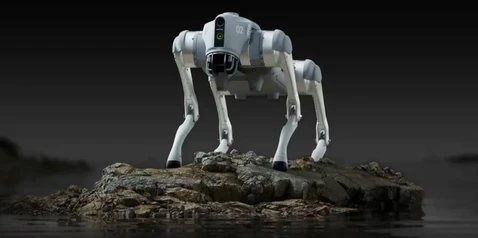
Our research advances quadruped locomotion with a focus on its adaptivity, agility, and safety using state-of-the-art learning-based methods. We invite motivated students to join us. For more details on the topics below, or to learn about our most recent projects, please email your background to Yulong Xiao (yulong.xiao@tum.de).
Keywords: Quadruped locomotion, Reinforcement learning, Imitation learning
- [MA/GR/BA/SA] Learning Advanced Skills for Complex and Discrete Terrain
- [MA/GR/BA/SA] Differentiable Simulation for Efficient and Versatile Quadruped
Locomotion - [MA/GR/BA/SA] Safe Quadruped Locomotion: Out-of-distribution Detection and
Recovery - [MA/GR/BA/SA] Residual MPC: Blending Reinforcement Learning with GPU-Parallelized Model Predictive Control for Legged Robots
Bio-inspired Robotics in Complex Environments: Locomotion, Fault Tolerance, and Collaboration

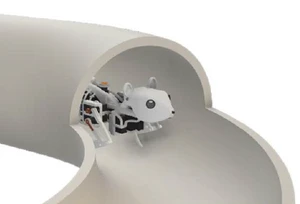
1.Collaborative Underground Mapping for Cross-Scale Heterogeneous Robots
[BA/SA/MA]: [Proposal]
Underground environments pose significant challenges for autonomous mapping due to complex terrains, making single-robot coverage insufficient. To overcome this, cross-scale heterogeneous robot teams offer a promising solution by combining large robots for global localization and computing with small robots for exploring narrow, high-risk gaps. However, challenges like sensor fusion, communication limits, and payload constraints persist. This project proposes a mothership-child collaborative exploration system. The mothership acts as a centralized sensing and computing hub, guiding child robots that explore inaccessible areas. Ultimately, the project aims to develop a framework for efficient multi-robot cooperation and accurate map construction.
2.Locomotion of a Rat Robot with 3-DOF Legs in Curved and Narrow Spaces
[BA/SA/MA]: [Proposal]
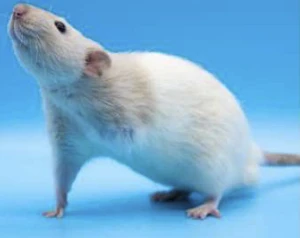
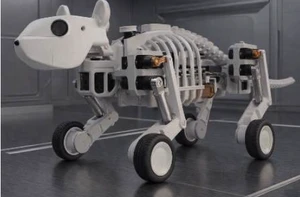
Small-scale quadruped rat robots offer significant potential for exploring confined areas, but balancing a compact design with maneuverability remains a challenge. While traditional biomimetic spines require too much clearance for narrow spaces , a previously designed 3-DOF limb structure successfully optimized linear movement. However, how this structure handles complex turning is still untested. Because tight L-shaped or U-shaped tunnels impose strict turning radius limits , improving tight-turn passability and overcoming motion singularities—without sacrificing the robot's compact size—is essential for real-world applications.
3.Whole-Body Balance Control for Injured Quadrupedal Robots
[BA/SA/MA]: [Proposal]
Small-scale quadruped rat robots offer significant potential for exploring confined areas, but balancing a compact design with maneuverability remains a challenge. While traditional biomimetic spines require too much clearance for narrow spaces , a previously designed 3-DOF limb structure successfully optimized linear movement. However, how this structure handles complex turning is still untested. Because tight L-shaped or U-shaped tunnels impose strict turning radius limits , improving tight-turn passability and overcoming motion singularities—without sacrificing the robot's compact size—is essential for real-world applications.
4.Pathological Gait Generation for Injured Quadruped Robots Using Reinforcement Learning
[BA/SA/MA]: [Proposal]
While quadruped robots are highly adaptable, their complex architecture makes them susceptible to hardware failures like limb loss, which render standard control strategies ineffective. Preserving mobility requires generating a stable tripedal pathological gait, but coordinating the remaining limbs involves highly nonlinear constraints that are difficult for conventional model-based methods to handle. Reinforcement learning (RL) offers a solution by autonomously discovering compensatory coordination through simulation, providing a highly resilient approach for fault-tolerant control and gait generation under complex damage conditions.
5.Pathological gait generation for rat robot with spine-based damage control
[BA/SA/MA]: [Proposal]
Quadruped robots rely on precise foothold selection for mobility. However, irreparable limb failure disrupts this ability, causing asymmetric motion and severe issues with movement direction and dynamic balance. Consequently, damage control mechanisms are rarely applied to quadrupeds compared to hexapods. Inspired by animals that utilize their spines for movement direction and balance , this research explores damage control using a rat robot equipped with a flexible spine. The objective is to generate pathological gaits that enable the robot to maintain balance and continue task execution despite irreversible limb damage.
6.Design of a Wheel-Legged Rat Robot for Enhanced Mobility
[BA/SA/MA]: [Proposal]
While rat robots are ideal for exploring confined spaces, their small size inherently restricts their actuation, payload, and obstacle-clearing capabilities. Relying purely on legged locomotion often results in low speed, high energy consumption, and poor adaptability in mixed environments. To address this, converting rat robots into wheel-legged platforms offers a highly effective solution. This hybrid approach combines the speed and energy efficiency of wheeled motion on flat surfaces with the obstacle-negotiation advantages of legged systems, ultimately overcoming size-induced constraints and significantly enhancing the robot's robustness and practical utility.
Mentor: Yuhong Huang(yuhong.huang@tum.de) Qian Huang(qian.huang@tum.de)
Shift2SDV: Autonomous driving - Systems and Software Engineering
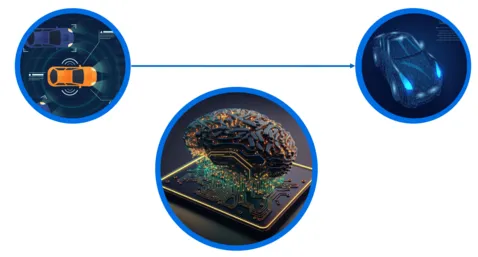

As part of the research project Shift2SDV, a group has come up to build a new system architecture for future vehicles with a focus on autonomous driving.
Systems and Software Engineering

Our group provides a range of topics related to systems and software engineering with applications in robotics and automotive.
Currently, the following thesis proposals are open:
- [SA/MA] Job Shop Scheduling with HPC
- [SA/MA/BA] Designing an Amphibious Vehicle: A Prototype Trial Using 3D Printing.
- [SA/MA] 3DGS-based SLAM in Dynamic Systems: Improving Dynamic Object Filtering and Efficiency.
- [SA/MA] 6-DOF Grasp Planning using Transformer-based Neural Networks.
- [MA] Performance study on transporting large-scale dataset.
- [MA] Multi-robot cooperation under signal temporal logic
- [SA/MA]Field Robotics - Autonomous Driving in Unstrutured Scenarios
- [SA/MA]Field Robotics - Autonomous Driving in Smart Mining
- [SA/MA]Field Robotics - Space Robotics
Reinforcement Learning, Representation Learning, Meta-RL and Robotics
Three of our DEMOs can be found at https://sites.google.com/view/kuka-environment/ , https://sites.google.com/view/cemrl, and https://videoviewsite.wixsite.com/rlsnake.
- Meta-RL:
- RL:
- Language-conditioned Meta-RL:
- Safety Control for Robotic Manipulator
We have several other open topics in the domain of reinforcement learning in robotics and we also accept open proposals or ideas with yourselves. For more information, please contact Zhenshan Bing.
Simulation-Based Learning Control for Real-World Robotic Manipulation and Navigation

- [MA/GR/IDP] Reinforcement Learning for Tower Crane 3D Lift Control contact: Hossein Malmir
- [BA/MA/GR/IDP] Photorealistic Rendering and Simulation in Robotics with Unity contact: Josip Josifovski
- [BA/MA/GR/IDP] Comparative Sim2Real Path Planning for AGV Navigation contact: Hossein Malmir
For more information about other available topics in reinforcement learning, data-driven control, and sim2real transfer, please contact Hossein Malmir.
Model Predictive Control for Quadruped Robots

Neural SLAM and Biomimetic Rodent Robot

- [MA/BA] Design and Control of a Rat Robot with Actuated Spine and Ribs
- [MA/BA] Biologically Plausible Spatial Navigation (NeuralSLAM)
- [MA/BA] Brain-inspired Localization and Mapping based on LiDAR Sensor
- [MA/BA] Pathological gait generation for rat robot with spine-based damage control
- [MA/BA] Rewiring the CPG controller during rat robot error behaviors
For more information about this topic, please contact Zhenshan Bing and Florian Walter.
BMW - Source-Agnostic Cooperative Perception
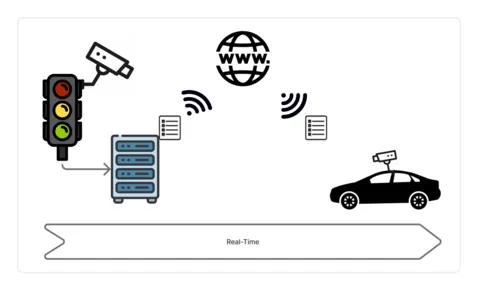
As part of the research project from BMW, our focus is on the real-time infrastructure of the V2X communication and sensor fusion.
- [MA/FP] Efficient Real Time V2X Data Transmission and Object Extraction
- [MA/FP] Object List Generation and Extraction for V2X Communication
For more information about this topic, please contact Kuo-Yi Chao.
HAL4SDV - Systems Safety Security Software
HAL4SDV, or the Hardware Abstraction Layer for Software-Defined Vehicles, is a European research initiative aimed at revolutionizing the automotive industry by developing a standardized hardware-software integration framework.
This project supports the transition to Software-Defined Vehicles (SDVs), where software plays a central role in vehicle functionality, allowing for over-the-air updates, modular design, and enhanced customization.
Key goals of HAL4SDV include:
- Creating a unified interface between vehicle hardware and software to simplify development processes.
- Enabling faster deployment of new features and ensuring high safety and performance standards.
- Supporting both safety-critical and general-purpose vehicle applications.
- Enhancing collaboration across European countries to build a comprehensive SDV ecosystem.
We are looking for eager and motivated students to work on the following topics:
Application of Retrieval-Augmented Generation (RAG) Systems in Standard Compliance
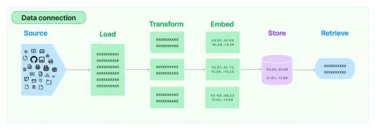
We are looking for a self-motivated student to work on extracting test scenario for autonomous driving research using RAG system:
- [GR/FP/IDP/SA/BA/MA/etc.] Comparison of Retrieval-Augmented Generation (RAG) Systems for Extracting Test Scenarios from UN Regulations
We have other open topics in the domain of Large Language Models in autonomous driving software development and we also accept open proposals or ideas with yourselves. For more information, please contact Vahid Zolfaghari.
Spiking Neural Networks - Next Generation AI for Autonomous Driving
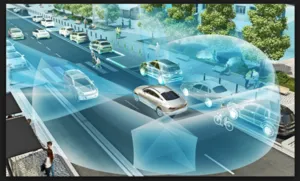
At the KI-ASIC project we are researching about the application of bio-inspired neural networks to real-world applications.
If you are interested in learning about neuroscience and how neuromorphic engineering is trying to narrow the gap between biology an technology, do not hesitate to contact us.
Available:
Previous topics:
Reinforcement Learning with Diffusion Models
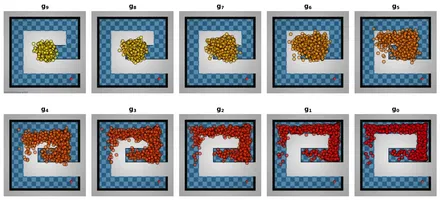
There are a few simulation oriented Bachelor and Master thesis in the following topics. If you are interested, feel free to contact us at erdi.sayar@tum.de
Cyber-Physical Systems

Cyber-physical systems — physical devices, enhanced by computational algorithms, that interact with their environment — are pervasive in today's society. Applications include autonomous driving, surgical robots, power grids, space exploration, and many more. All these use cases are safety-critical, as failures can cause severe economic and ecologic damages. At the Cyber Physical Systems Group, we develop methods to provably guarantee safe operation of these systems during deployment. We offer thesis topics in the following areas:
- Autonomous Vehicles
- Modular Robotics
- Safe & Multi-Agent & Offline Reinforcement Learning
- Robust and Nonlinear Motion Planning & Control
- Machine Learning and Optimization
- Formal Methods and Reachability Analysis
- Mobile Robotics for Construction Tasks
Please check our website for an up-to-date list of open topics.
Deep Learning for Computer Vision

If you are interested in researching trending topics in the field of computer vision and pattern recognition:
- Object detection
- Segmentation
- Tracking
- Surface reconstruction
- Mesh generation
- Text-to-image generation
- Domain adaptation of synthetic data
then please contact: Bare Luka Žagar
Offline Reinforcement Learning
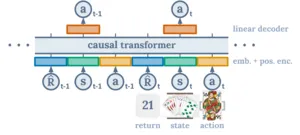
Safe Reinforcement Learning, Multi-Agent Reinforcement Learning
Reinforcement Learning for Safe and Efficient Combustion Engine Control
Neurorobotics in the Human Brain Project
- Developmental Body Modeling in Soft Robotics
- Cloud-Based Robotics for Machine Learning
- Virtual Neurorobotics with Intel Loihi
- Spiking Compliant Robot Control with Intel Loihi
- Integration of the Neural Simulator NEST into the Neurorobotics Platform
- Deep Spiking Q-Networks
- Autonomous Locomotion Control for Snake Robot Based on Bio inspired Vision Sensor and Spiking Neural Network
- Advanced Autonomous Driving Control Based on Bio inspired Vision Sensor and Spiking Neural Network
- Spiking Neural Network for Autonomous Navigation based on LiDAR Sensor
- Deep Spiking Reinforcement Learning
- Learning adaptive target reaching with Recurrent Neural Networks
- Biologically-inspired Perception for Autonomous Vehicles based on LiDAR Sensor
Machine Learning Algorithms for Hybrid Vehicle Data
Please see this page for the available topics about 3D Object Detection and Tracking.
Autonomous Robot & Visual Servo & Deep Learning & Robot Design & Medical Robotics
For more information, please visit my homepage Mingchuan Zhou or contact me via email (zhoum@in.tum.de).
OSBORNE (Future Automotive E/E Architectures for Autonomous Cars)
We have a set of open topics in the domain of affective computing and multimodal emotion recognition, within the context of OSBORNE project, for more information please contact Sina.
HORSE / REMODEL
We have several open topics related to computer vision in the HORSE and REMODEL projects. Please contact Arne for more details.
Collaboration with Chair for Product Development and Lightweight Design
External thesis proposals
- Masterthesis – Grey-Box Modellierung und Validierung des Motoraufheizverhaltens auf dem Rollenprüfstand und im Fahrzeug mittels Machine Learning
- [Master Thesis or Working Student] LLM for robotics with multi-fingered hand (Agile Robots AG)
Robot learning for Dexterous Hands
Sim2real transfer with Scaling up Diffusion/Flow matching Policies for Dexterous Manipulation
Low-level vision
For more information, please visit my homepage (Yuning Cui) or contact me via email (yuning.cui@in.tum.de).